
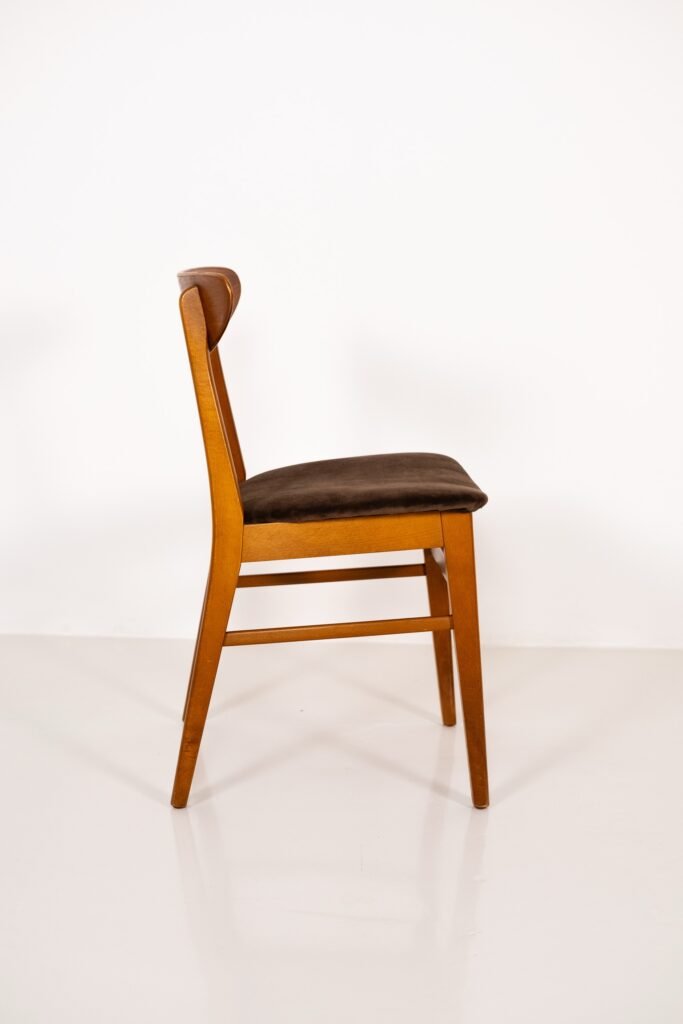
How to Identify Authentic Danish Mid-Century Furniture
In short: Authentic Danish mid-century furniture usually carries a maker’s mark, shows quality joinery, and has wear consistent with its age. No single sign proves authenticity, so check several together and ask the seller for documentation.
1. Look for maker’s marks
Many Danish manufacturers marked their furniture with a stamp, a paper label or a brand burned into the wood. Check the underside of tabletops, the inside of drawers, seat frames and the back of cabinets. Labels can be missing from genuine pieces because they wear off, so a missing mark is not proof of a fake, but a clear mark helps.
2. Check the wood and the veneer
Teak was the signature wood of Danish mid-century design. Much teak furniture uses teak veneer over a stable core, which is normal and often better for stability than solid wood. Look at the grain: on veneer pieces the pattern should continue sensibly across the surface and around edges. Solid teak is heavy and has a warm, slightly oily feel.
3. Study the joinery
Quality pieces use dovetail joints in drawers, mortise-and-tenon or dowel joints in frames, and carefully shaped edges. Visible staples, plastic fittings and thick modern glue lines suggest a later or lower-quality piece.
4. Expect honest age
Small scratches, gentle colour changes and softened edges are normal. Be cautious of furniture that looks too perfect and has no signs of age, or of pieces with a uniform dark stain hiding the wood.
5. Compare against known designs
Designs like the Arne Vodder FD164 lounge chair or Hans Olsen’s armchairs have well-documented proportions. Compare photos with museum or auction references. Many designs were also copied, so proportions and details matter.
6. Ask the seller
A reliable seller can explain where a piece came from, what has been restored and what is original. At Sozo we describe condition and any restoration openly.
FAQ
Is furniture without a label fake?
Not necessarily. Labels fall off or get removed during refinishing.
Is veneer a bad sign?
No. Veneer was standard practice in high-quality Danish furniture.
Can a restored piece still be authentic?
Yes, as long as restoration is careful and disclosed.